As I mentioned in one of my previous posts, I was on my way to Latvia. Well here I am. I was accommodated in a
hotel Centra. It is meant to be a four star hotel but... I wouldn't give it 3 :) The welcoming was a bit strange. I had booked it via booking.com and the price was a bit higher than from the hotel website. So although I had booked and payed for the hotel I was asked at the reception for my credit card number. MMMM? Rather strange. I have never been asked something like this. They wanted "a deposit" for the mini bar". This is the first time ever that I have been asked something like this. I asked my colleague who stayed in the same hotel and he hasn't been asked. I came back to the same hotel for the last evening of my stay and I wasn't asked about the card number either. Was it something wrong with the guy at the reception I don't know. Next to him there was a pretty looking young blond girl who was definitely not working in the hotel. She looked like she was waiting for something... Well This whole thing made me to be a bit superstitious so to calm down the atmosphere we agreed that I would just leave some cash for a deposit and that would be it. On the next day everything was fine. I was given it back but it was quite an experience. So have it mind when travelling.
On the next day I met my colleagues and here we are on our way around the bogs, marshes and coastline of Latvia. Beautiful scenes. The plan was to do some birdwatching in the bright part of the day and do the work discussions when it is dark. Since it is now the end of November the day isn't going be quite long. At this time of the year it is usually around 7-8 hours long.

The first place where we went was
Kemeru-smardes bog national park which has a lovely logo. I was wondering why it is a woodpecker since the area is mainly a bog but then I realised that in the area you can see all the 9 species of woodpecker species in Latvia.
In spring the area is good for the breeding wood sandpipers, golden plovers, cuckoos, skylarks, tree pipits, yellow wagtails and other birds. Now, it was totally empty. The forest at the entrance of the part had a couple of Great spotted Woodpeckers and Goldcrests but that's about it.
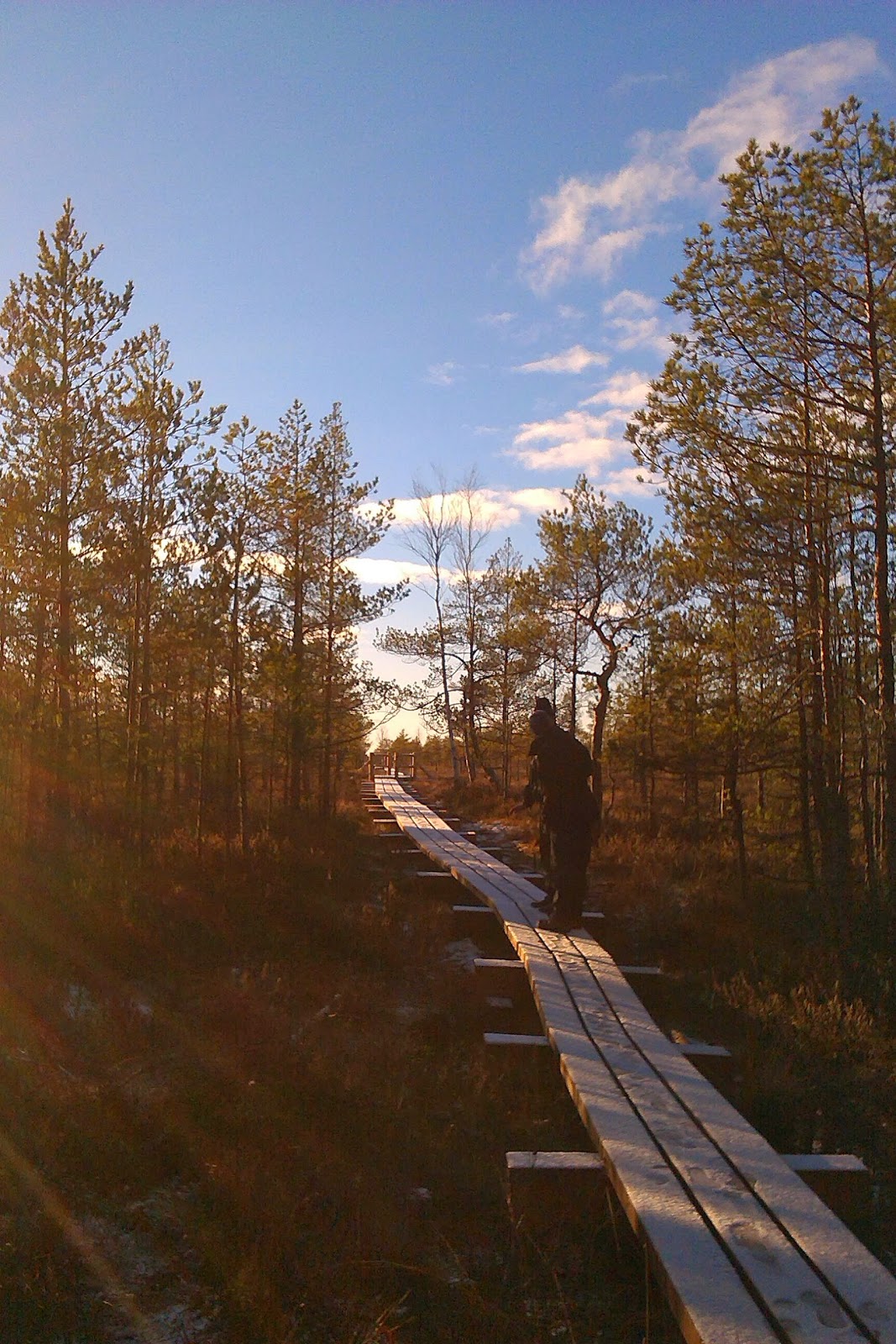
We walked along a recently renovated trail in the bog and went back. This bog is so called 'raised'. On the scheme below you can see what that means. The bog was formed in the
preboreal age from a lake that must have existed at that time. The trail was built using well connected pieces of wood which seem to be mobile. Now it was very dry but in spring I would image the bog is rather wet and the water level raises. Thus the trail should not be left under water ;)
 |
| the entrance to the national park |
 |
| a new nicely designed trail in Kemeru-smardes national park leads into the bog |
 |
| Kemeru-smardes bog national park |
 |
| A part of the bog which is quite dry at this time of the year and totally short of birds now |
After looking around the bog we went to the visitors centre of the national park. It was closed but at least we saw what the building was like. The area is suitable for all the 9 species of woodpeckers you can find in Latvia. For a couple of minutes that we stayed around we saw only the middle spotted but there were singes of lesser spotted and a table suggesting the distribution of all the species.
 |
| Visitors centre and administration of the National Park |
Here is a lovely map of the area with a few birding locations ready to download as a pdf.
After the national park we headed towards the coast where we expected to find more birds. Before that we stopped in a lovely place for lunch (57.3397, 23.1184).The food was great and owner of the place speaks good english and seems to be a great character with nice sense of humor. We had some pork fillet with mushroom and a meatball soup. After this fairly heavy meal I couldn't move much. It was so heavy that I didn't feel like having dinner at all.
We went to the coast to a place called Mērsrags. Finally some birds. The long expected Long-tailed ducks were nicely sitting nearby. A couple of Red-breasted Mergansers and quite a few Mute Swans and Goldeneye were all that we could tick at this spot.
Well that was about this day. Not much birding but lovely habitats. I quite enjoyed the flat country. There is some character in the setting around. Although it is meant to be a poor country Latvia looks well arranged with nice roads and higher standard than Bulgaria. The houses seem somehow "open" with big windows showing that people have some comfort and nobody seems to be disturbing them. Crime is perhaps not a big problem or at least not in the countryside. Well generally the local currency Lata is stronger than the EURO.
We finished the day in the field station on
lake Engure managed by the local biology institute. People here are working mainly on ducks. The lake is known for its rich diversity of birds. A nature protection regime was established in 1957. The lake was included in the Important Bird Area list in 1994, in the Ramsar lists in 1995, and as part of the Natura 2000 network in 2004. A paper from 2012 discusses some of the factors influencing the number of breeding birds on the lake. It is mostly with data collected by the Laboratory of Ornithology, Institute of Biology, in the period 1948–2011. You can
download it as a pdf from here or see the
abstract only here.
Here everything is with a focus on birds, even the table cover was with bird paintings :)
 |
| table cover in the field station of lake Engure |
The evening at the field station was fairly cold. We had a rather productive discission about the future if the bird id programme in Latvia, had a few drinks and soon went to bed. In the morning we had a look at a rather romantic floating house which was abandoned many years ago. We got the local stories for scientists that have been working through the early years of their career which revealed more of the identity of this place. About 50+ mute swans and about the same number of Goldeneye were swimming on the lake. At night we had a Bittern calling from the reed beds.
Soon we left to the airport. Our trip had to end. An exciting observation at a gas station revealed over a 100 Waxwings which I was hoping that we will see during the trip here. Beautiful birds!
Well that's about it for now. I will spend the afternoon in the old part of the city centre of Riga and have dinner in extraordinary restaurant where they serve dinner not on plates but on paper....
The dinner was pretty...interesting. We went to a place called "
3 Chefs". Rather intriguing place. I have linked the name of the place to Trip Adviser for you to see some of the comments about the place. Generally it wasn't spectacularly delicious. Yes it was the most interesting and different dinner I have ever had. There was some 'welcoming' by drawing an abstract drawing by a variety of sauces on a piece paper right in front of you. The souse was edible so using pieces of bread you can collect it from the paper. I must say it was rather intriguing idea. I think the guy that was doing it was a street painter of graffiti or sprays. Then the main dish was a bit strange. I had duck breast with some vegetables. Well, like a 'smart' restaurant there were 3 pieces of duck breast, two pieces of potatoes and a plums souse which was giving a bit of acid flavour. Not my type of thing really but you might enjoy it :) Still it was a nice experience. The beer and the bread were nice ;) The services was also great.
Here is a checklist of the birds that we saw during the trip:
| # |
species |
| 1 |
Mute Swan
- Cygnus olor |
| 2 |
Mallard - Anas
platyrhynchos |
| 3 |
Common Scoter - Melanitta nigra |
| 4 |
Long-tailed Duck - Clangula
hyemalis |
| 5 |
Common Goldeneye - Bucephala
clangula |
| 6 |
Red-breasted Merganser - Mergus
serrator |
| 7 |
Red-throated Loon - Gavia
stellata |
| 8 |
Great Crested Grebe - Podiceps
cristatus |
| 9 |
Eurasian Bittern - Botaurus
stellaris |
| 10 |
Common Buzzard - Buteo buteo |
| 11 |
Black-headed Gull
- Chroicocephalus ridibundus |
| 12 |
Mew Gull - Larus canus |
| 13 |
Great Black-backed Gull - Larus
marinus |
| 14 |
European Herring Gull - Larus
argentatus |
| 15 |
Middle Spotted Woodpecker
- Dendrocopos medius |
| 16 |
Great Spotted Woodpecker
- Dendrocopos major |
| 17 |
Eurasian Magpie - Pica pica |
| 18 |
Hooded Crow - Corvus cornix |
| 19 |
Common Raven - Corvus corax |
| 20 |
Western Jackdaw - Coloeus
monedula |
| 21 |
Bohemian Waxwing - Bombycilla
garrulus |
| 22 |
Willow Tit - Poecile montanus |
| 23 |
Coal Tit - Periparus ater |
| 24 |
Crested Tit - Lophophanes
cristatus |
| 25 |
Great Tit - Parus major |
| 26 |
Goldcrest - Regulus regulus |
| 27 |
Eurasian Nuthatch - Sitta
europaea |
| 28 |
Fieldfare - Turdus pilaris |
| 29 |
Eurasian Tree Sparrow - Passer
montanus |
| 30 |
European Greenfinch - Chloris
chloris |
| 31 |
Eurasian Siskin - Spinus spinus |
| 32 |
Hawfinch - Coccothraustes
coccothraustes |